In the Trenches
I've been having the same conversation for 15 years.
"We need to keep everything on-premise. Security. Compliance. Control."
And every time, I ask the same question: "When was the last time your internal IT team detected and patched a zero-day vulnerability faster than AWS, Azure, or Google Cloud?"
Silence.
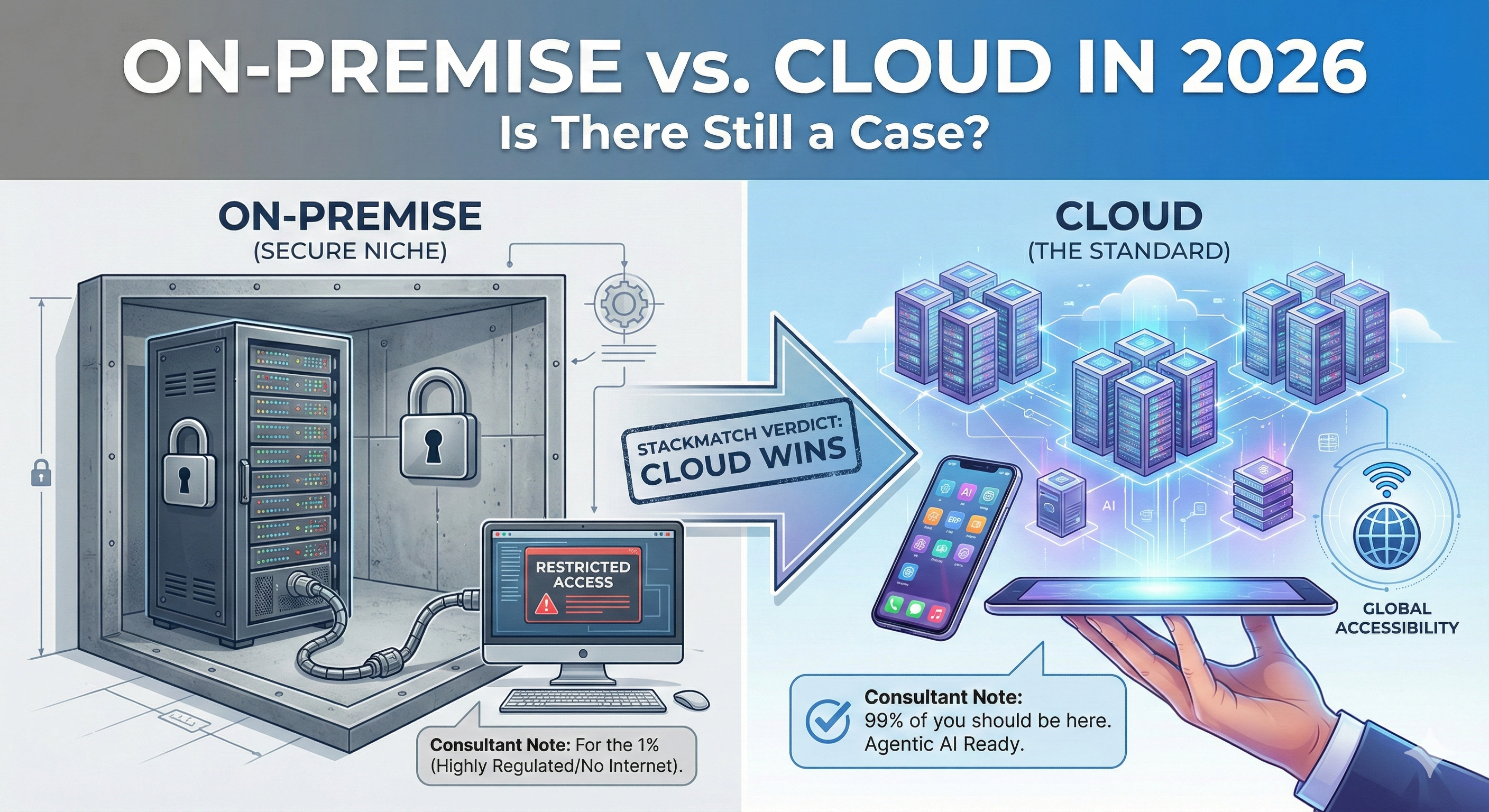
Here's my honest take after helping hundreds of companies navigate this decision: 99% of you should be in the cloud. The remaining 1%—those in heavily regulated industries with specific data sovereignty requirements—should be running a hybrid model. Pure on-premise in 2026? That's increasingly a liability, not an asset.
Let me break down why.
The "Vendor vs. Reality" Gap
The cloud vs. on-premise debate is plagued by outdated assumptions. Here's what vendors tell you versus what the data actually shows:
| What Vendors Say | What the Data Shows |
|---|---|
| "Cloud is less secure" | Cloud providers employ 1,000+ security engineers; you have 3. AWS has more security certifications than most enterprises will ever achieve. |
| "On-premise gives you control" | True—you control patching schedules, which means you're 2-3 weeks behind on critical security updates. That's not control; that's exposure. |
| "Cloud costs spiral out of control" | Only if you don't manage it. Companies with proper FinOps practices see 23% average savings within the first year of migration. |
| "Migration is too risky" | The average data breach costs $4.45 million. The average cloud migration costs a fraction of that and reduces breach probability. |
| "We need data on-site for compliance" | Most compliance frameworks (HIPAA, SOC 2, GDPR) have approved cloud configurations. Only a handful of edge cases truly require on-premise. |
The reality is that cloud infrastructure has matured dramatically. The security advantages of having dedicated teams at hyperscalers managing your infrastructure almost always outweigh the perceived benefits of "keeping data close."
The Core Definition (The "What")
Let's cut through the jargon and define what we're actually comparing:
Cloud (SaaS/IaaS/PaaS)
Your software and/or infrastructure runs on someone else's hardware in their data centers. You access it over the internet. Someone else handles:
- Hardware maintenance and replacement
- Security patching and updates
- Physical security
- Redundancy and disaster recovery
- Scaling capacity up and down
Examples: Salesforce, AWS, Microsoft 365, Google Workspace, virtually every modern B2B SaaS tool.
On-Premise
Your software runs on hardware you own, in data centers you control (or lease). You handle:
- Hardware procurement and maintenance
- All security patching
- Physical security
- Disaster recovery planning and execution
- Capacity planning and hardware purchases
Examples: Self-hosted ERP systems, legacy financial systems, some government installations.
Hybrid
A combination where some workloads run in the cloud, others run on-premise, with connectivity between them.
Examples: Sensitive data processing on-premise with cloud-based analytics; cloud disaster recovery for on-premise production systems.
The 3 Critical Features (That Actually Matter)
When evaluating cloud vs. on-premise, stop arguing about theoretical scenarios. Focus on these three factors that actually determine the right answer for your organization:
1. Security Posture Reality
The question isn't whether cloud is secure. It's whether your on-premise setup is MORE secure.
For 99% of organizations, the answer is no. Here's why:
- Patching velocity: AWS patches critical vulnerabilities within hours. Your IT team does a "monthly patch cycle" (at best).
- Talent density: Microsoft's Azure security team has more security engineers than most companies have total employees.
- Attack surface: Your on-premise data center is one target with one team defending it. Cloud providers distribute your data across dozens of secured facilities.
- Compliance burden: Cloud providers have pre-built compliance frameworks (HIPAA, SOC 2, FedRAMP, GDPR). You'd spend millions building equivalent controls.
The 1% exception: If you're a defense contractor handling classified information, a government agency with specific data sovereignty laws, or processing data that literally cannot leave certain jurisdictions by law—hybrid or on-premise may be required. But even then, classified enclaves within cloud providers (AWS GovCloud, Azure Government) often satisfy these requirements.
2. Total Cost of Ownership (TCO)
The TCO comparison is often manipulated by both sides. Here's an honest breakdown:
On-premise costs people forget:
- Hardware refresh cycles (every 3-5 years)
- Electricity and cooling
- Physical security
- IT staff to manage infrastructure (loaded cost: $150K-$250K per engineer)
- Opportunity cost of IT focus on infrastructure vs. business applications
- Disaster recovery site (typically 30-40% additional cost)
- Insurance
- Compliance audit preparation
Cloud costs people forget:
- Egress fees (data leaving the cloud)
- Premium support tiers
- Reserved instance commitments
- Cost optimization overhead (FinOps)
- Network connectivity to cloud
The math: For most organizations, cloud wins when you account for fully-loaded costs. A 2024 Flexera study found that 94% of enterprises are using cloud services, with the average organization running 2.5 clouds. The trend is clear.
The exception: If you have extremely predictable, steady-state workloads with no variability, own real estate with cheap power, and have a large existing IT staff—on-premise can occasionally be cheaper. This is rare.
3. Business Agility
This is where cloud provides an advantage that's hard to quantify but impossible to ignore:
- Time to new capability: Days (cloud) vs. months (on-premise procurement cycles)
- Scaling for demand: Minutes (cloud auto-scaling) vs. weeks (order, ship, rack, configure)
- Geographic expansion: Configuration change (cloud) vs. new data center buildout (on-premise)
- Experimentation cost: Pennies (spin up, test, destroy) vs. capital expenditure (buy hardware that might not be used)
In 2026, the ability to move quickly is a competitive advantage. On-premise infrastructure is a boat anchor.
The "Gotchas" (Red Flags)
Red Flags When Choosing Cloud
- No egress strategy: If you can't extract your data, you're locked in
- Single-cloud dependency for critical systems: Multi-cloud or hybrid provides resilience
- No cost governance: Cloud costs can spiral; implement FinOps from day one
- Compliance assumptions: Verify your specific regulatory requirements are met by your cloud configuration
- Lift-and-shift without optimization: Moving bad architecture to cloud just makes expensive bad architecture
Red Flags When Choosing On-Premise
- "Security through obscurity": Hiding doesn't protect; proper security architecture does
- Underestimating staffing costs: You need 24/7 coverage for production systems
- No disaster recovery plan: On-premise without DR is one flood/fire/hurricane away from business discontinuity
- Compliance theater: Having data on-site doesn't automatically mean you're compliant
- "We've always done it this way": The most expensive words in business
Who Should Buy What (The Segmentation)
Let me be direct about who should choose what:
Cloud is Right For (99% of Organizations)
- Startups and SMBs: You cannot afford the infrastructure and talent required for secure on-premise. Don't even consider it.
- Mid-market companies: Your IT team's time is better spent on business applications than infrastructure management.
- Enterprises without specific regulatory requirements: Even large organizations benefit from cloud scale and security posture.
- Any organization prioritizing agility: If you need to move fast, cloud is the only answer.
Hybrid is Right For (~0.9% of Organizations)
- Regulated industries with specific data sovereignty requirements: Healthcare (certain PHI processing), financial services (some trading systems), government contractors
- Organizations with massive, predictable compute workloads: If you're running steady-state HPC that's truly predictable, on-premise compute with cloud burst capacity can work
- Companies with existing data center investments: Use what you have, but new workloads go to cloud
Pure On-Premise is Right For (~0.1% of Organizations)
- Classified government operations: True air-gapped requirements
- Specific edge computing scenarios: Latency-critical manufacturing, remote locations without connectivity
- Organizations where regulation explicitly prohibits cloud: Rare, but they exist
If you're reading this blog, you're probably not in the 0.1%.
The StackMatch Solution
Here's the thing: this decision is just one of hundreds you'll make during a software procurement cycle. Cloud vs. on-premise, best-of-breed vs. suite, build vs. buy, vendor A vs. vendor B.
The old way: Spend weeks researching, create a 1,000-page RFP, wait months for responses, compare apples to oranges.
The StackMatch way: Tell us what you're looking for—your industry, your size, your requirements, your dealbreakers—and we'll match you with the right software and deployment model for your situation.
Our AI-powered RFQ creation walks you through 29 category-specific blueprints in about 15 minutes (not the 6 hours traditional RFPs take). We ask the questions that actually matter, including deployment preferences, compliance requirements, and integration needs.
Then we connect you with pre-vetted vendors who compete for your business with transparent proposals. No more cold outreach. No more comparing incompatible responses.
Whether you've decided on cloud, are exploring hybrid, or have a genuine on-premise requirement, start your RFQ today and find the stack that fits your reality—not a vendor's quota.
The bottom line: The cloud debate is effectively over for most organizations. The question isn't whether to use cloud—it's how to use it effectively. Focus your energy on vendor selection, implementation, and optimization rather than relitigating infrastructure decisions that have clear answers.
For the 1% with genuine hybrid or on-premise requirements: we see you, and we've built StackMatch to handle those requirements too. Just be honest with yourself about whether you're actually in that 1%.